Data Minimization ROI: Reduce Storage Costs with Data Retention Enforcement
How enterprises can turn data retention policy enforcement into measurable storage savings, lower risk, and a stronger business case.

Seth Knox
Table of Contents
- What is data minimization?
- Why unnecessary data becomes expensive
- How much enterprise data may be unnecessary?
- The potential ROI of data minimization
- Where enterprises can reduce unnecessary storage
- Why Data Retention Enforcement requires business context
- Data minimization also reduces breach exposure
- Data minimization is an ongoing discipline
- Build the business case for data minimization
- Get a Free Data Minimization ROI Analysis

Enterprises are creating and retaining more data than ever. Documents are copied across departments, cloud migrations leave source data behind, former employees leave unowned content, and completed projects continue consuming storage long after the information has served its purpose.
The result is an expanding collection of duplicate, redundant, obsolete, and trivial data that increases enterprise storage costs while creating unnecessary security, privacy, and compliance risk.
A strong data minimization strategy helps organizations retain only the data they need, for only as long as they need it. When combined with Data Retention Enforcement, organizations can consistently apply retention policies, delete expired or unnecessary information, reclaim storage capacity, and generate measurable cost savings.
| Modeled three-year storage benefits
1 PB: $533,750 | 5 PB: $2.67 million | 20 PB: $10.68 million |
These estimates include storage-related savings only. They do not quantify the additional value of reduced backup and replication consumption, delayed infrastructure expansion, lower migration costs, reduced breach exposure, or improved compliance.
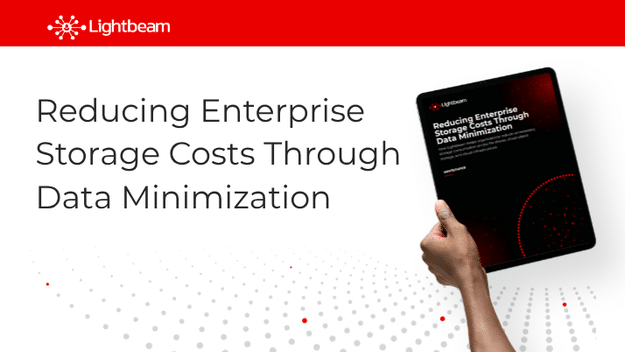
Download the full white paper: Reducing Enterprise Storage Costs Through Data Minimization
What is data minimization?
Data minimization is the practice of limiting the collection, use, storage, and retention of data to what is necessary for a legitimate business, operational, legal, or regulatory purpose.
In enterprise environments, data minimization commonly involves identifying and addressing information such as:
- Duplicate documents stored across multiple repositories
- Files associated with former employees or inactive departments
- Data copied during migrations but never removed from the source
- Temporary reports, exports, and analytical datasets
- Amazon S3 objects that no longer have an active purpose
- Unattached or orphaned Amazon EBS volumes
- Snapshots retained beyond their required lifecycle
- Contracts and records that have passed their retention period
- Sensitive data retained without a continuing business need
Data minimization is closely related to data retention, but the two are not identical.
A data retention policy defines how long specific information must or may be retained. Data Retention Enforcement applies those policies across enterprise systems and ensures that information is archived, restricted, or deleted when its required lifecycle ends.
Together, data minimization and Data Retention Enforcement create a practical framework for determining what should be kept, what can be removed, and when action should occur.
Learn how Lightbeam supports Data Retention Enforcement
Why unnecessary data becomes expensive
The cost of retaining data extends beyond the price of the primary storage device or cloud service.
A fully loaded enterprise storage cost can include:
- Primary storage capacity
- Backup storage
- Replication and disaster-recovery copies
- Snapshots
- Hardware and software support
- Cloud infrastructure support
- Storage administration and monitoring
- Power, cooling, and data-center space
- Reserved or unused capacity
- Future infrastructure expansion and refreshes
For example, high-volume Amazon S3 Standard capacity costs approximately $250 per TB annually before accounting for backup, replication, support, administration, and related infrastructure expenses.
Lightbeam’s data minimization model uses an illustrative fully loaded annual cost of $500 per TB to account for these broader enterprise storage costs.
At petabyte scale, every percentage point of unnecessary data represents a meaningful amount of continuing expense.
How much enterprise data may be unnecessary?
Research has consistently found that a significant portion of enterprise data provides limited or no continuing value.
Veritas research estimated that approximately 28% to 33% of enterprise data was redundant, obsolete, or trivial, commonly called ROT data. Komprise has estimated that duplicate data alone can account for 30% to 40% of an average enterprise data footprint.
These figures do not mean every organization can immediately delete the same percentage of its data. Retention requirements, legal holds, contractual obligations, regulatory requirements, ownership, and business dependencies must be considered.
However, they demonstrate why a 28% data-reduction assumption can be useful for high-level financial modeling. It is at the lower end of several industry estimates and is tied specifically to redundant, obsolete, and trivial information.
The potential ROI of data minimization
The economic impact becomes clear when the 28% data-reduction benchmark is applied to enterprise environments of different sizes.
The following examples assume:
- 28% reduction in stored data
- $500 fully loaded annual storage cost per TB
- 25% annual enterprise data growth
- A three-year period
- 1 PB equals 1,000 TB
| Environment | Year 1 data reduced | Year 1 | Year 2 | Year 3 | 3-year benefit |
|---|---|---|---|---|---|
| 1 PB | 280 TB | $140,000 | $175,000 | $218,750 | $533,750 |
| 5 PB | 1.4 PB | $700,000 | $875,000 | $1,093,750 | $2,668,750 |
| 20 PB | 5.6 PB | $2,800,000 | $3,500,000 | $4,375,000 | $10,675,000 |
These examples focus only on storage economics. They do not include potential savings from backups, replication, disaster recovery, migrations, administrative effort, or delayed infrastructure purchases.
While Lightbeam is a data security platform, the storage-related cost savings associated with data minimization alone can more than justify the investment in the solution.
Where enterprises can reduce unnecessary storage
Data minimization opportunities exist across both on-premises and cloud environments.
Reclaim capacity on SMB and network file shares
SMB shares commonly contain years of accumulated departmental and user-generated data. Files may remain long after the associated projects, employees, or business processes are gone.
Organizations need more than file age to determine whether information should be deleted. They also need to understand:
- What the file contains
- Whether it includes sensitive or regulated data
- Who owns it
- Who can access it
- Whether another copy exists
- Whether it is subject to a retention policy or legal hold
- Whether it supports an active business process
Applying this context allows enterprises to reclaim capacity without treating every old file as disposable.
Reduce Amazon S3 consumption
Amazon S3 is consumption-based, so unnecessary objects can create a direct and continuing monthly expense.
Common S3 data minimization opportunities include:
- Duplicate objects across buckets
- Old exports and reports
- Abandoned analytical datasets
- Data copied during cloud migrations
- Development and testing data
- Objects retained after their business purpose ended
- Sensitive data stored in unmanaged locations
Deleting eligible objects may directly reduce storage charges, depending on storage class, minimum-duration rules, contractual commitments, and other customer-specific factors.
Identify orphaned EBS storage
Amazon EBS volumes can continue generating charges after the related EC2 instance, application, or project has been decommissioned.
Potential candidates include:
- Volumes left after an EC2 instance is terminated
- Storage created for temporary development or testing
- Volumes without a current business owner
- Storage tied to abandoned applications
- Oversized or underutilized volumes
- Snapshots retained beyond approved lifecycle requirements
Finding an unattached volume is only the first step. Organizations must connect it to an owner, application, business purpose, sensitivity level, and retention requirement before taking action.
Why Data Retention Enforcement requires business context
Many traditional data retention programs rely primarily on file creation dates, last-modified dates, or repository locations. These broad rules often lack the business context required to determine when a specific document has reached the end of its required lifecycle.
Lightbeam Smart Templates enable organizations to identify context within the document itself and use that information to trigger the appropriate retention, archival, or deletion policy.
Examples include:
- Enforcing deletion or archival based on a contract end date
- Applying a retention policy based on an application or submission date
- Retaining a record until a data subject reaches a defined age
- Triggering an action based on a termination, expiration, or renewal date
- Applying different policies based on the individual, business entity, or record type represented in the data
This allows organizations to move beyond broad file-age rules and enforce data retention policies based on the actual business event that determines when information is no longer required.
Lightbeam can then archive, mask, restrict, or delete data according to policy while preserving evidence of the action.
Explore Lightbeam Data Retention Enforcement
Data minimization also reduces breach exposure
Unnecessary data creates a security problem as well as a storage problem.
Every additional copy of sensitive information increases the number of places attackers, compromised accounts, malicious insiders, ransomware, and unauthorized AI tools may be able to reach.
Data minimization can reduce:
- The probability that sensitive data is exposed
- The volume of data available to a compromised identity
- The number of repositories affected during an incident
- The effort required to investigate affected information
- The potential blast radius of a breach
This risk reduction is financially significant. IBM and the Ponemon Institute reported that the average cost of a U.S. data breach reached $10.22 million.
Removing data that no longer has a legitimate purpose means there is less information to lose, encrypt, exfiltrate, investigate, notify, or remediate.
Data minimization is an ongoing discipline
A one-time cleanup may reclaim storage, but enterprise data continues to grow.
IDC forecasts cited in the Lightbeam model indicate that global data creation is growing at approximately 24.4% annually, which the model rounds to 25%. As new data is created, new duplicates, stale copies, expired records, and orphaned resources also accumulate.
An effective data minimization and Data Retention Enforcement program therefore follows a continuous process:
- Discover and classify enterprise data.
- Identify duplicate, obsolete, expired, and orphaned information.
- Connect the data to identities, owners, applications, and business processes.
- Apply data retention, privacy, legal-hold, and security requirements.
- Route proposed actions to the appropriate owners.
- Archive, restrict, mask, or delete approved data.
- Record the decision and remediation evidence.
- Repeat the process as data and policies change.
Lightbeam automates this process across diverse data sources while grounding decisions in sensitivity, identity, ownership, access, policy, and business context.
Its Data Retention Enforcement capabilities help organizations reduce storage waste, breach exposure, and legal liability without relying on manual audits or complex scripts.
Build the business case for data minimization
Data minimization and Data Retention Enforcement can generate measurable storage cost savings while strengthening security, governance, and compliance.
The full Lightbeam white paper explains:
- How to estimate the ROI of data minimization
- The research supporting the 28% data-reduction benchmark
- The basis for the $500 fully loaded annual storage-cost assumption
- How continued enterprise data growth increases the financial opportunity
- Detailed cost-savings scenarios for 1 PB, 5 PB, and 20 PB environments
- Opportunities across SMB shares, Amazon S3, EC2, and EBS
- Additional benefits involving backup, migration, breach exposure, and compliance
Learn more about how Lightbeam helps enterprises enforce data retention policies and automate data minimization.
Get a Free Data Minimization ROI Analysis
See how much your organization could save by reducing redundant, obsolete, expired, and orphaned data. Lightbeam will provide a complimentary analysis using your data footprint, storage environment, growth rate, and retention priorities to estimate potential storage savings and identify high-value opportunities for Data Retention Enforcement.