


Is Your RoPA Optimized?
Maximize your RoPA benefits with LightBeam. Streamline processes, automate tasks, and ensure GDPR compliance. Discover how to optimize your RoPA today.

Henna
Maximizing the Benefits of the Record of Processing Activities (RoPA) requirement.

Article 30 of the European Union’s General Data Protection Regulation(GDPR) contains the requirements for organizations to document their processing of personal and sensitive information. The RoPA is a critical component of the EU’s GDPR, and also one for mature organizations that utilize personal information as a part of their business.
A RoPA (Record of Processing Activities) is a GDPR-mandated log of how personal data is processed across an organization. Automating RoPA with tools like LightBeam simplifies compliance, enables privacy by design, and supports audits, risk management, and business insight.
Article 30 requires businesses to maintain comprehensive documentation of processing activities utilizing personal information.
The RoPA requirements include documenting;
– The name and contact details of the owner or controller of the data,
– The categories of personal data,
– Categories of data subjects,
– Categories of recipients,
– The purpose of processing,
– Time limits for keeping the data, and
– any international transfers of data.
Businesses initially understood RoPA as a strict evidentiary measure for their compliance with the GDPR, but soon after it emerged as a privacy by design feature to formally involve business and IT groups handling the data and a good way to self-audit records and gather insights related to personal sensitive data and the systems where the data is being used.
A well-structured RoPA offers numerous advantages beyond avoiding regulatory scrutiny and sanctions. It serves as evidence of good privacy practices, aids in targeting remediation activities, supports other privacy processes, acts as a risk management dashboard, and can even provide valuable business insights. Above all the RoPA creates an accurate understanding of what sensitive data exists in the environment and what is it being used for.
Key Benefits of a RoPA

– Evidence of Good Privacy Practices: A comprehensive RoPA demonstrates an organization’s understanding of the personal data being processed and compliance with many regulations. RoPAs can be a valuable driver of privacy by design efforts to engage business owners and a key asset during audits, breaches, or investigations.
– Input for Privacy Processes: The RoPA can inform various privacy activities, including privacy notices, data access requests, and privacy impact assessments.
– Targeted Remediation Activities: A RoPA helps identify areas requiring attention, such as outdated processes or compliance gaps, allowing for focused remediation efforts.
– Risk Management Dashboard: By adding a risk component, a RoPA can monitor risks, identify vulnerabilities, and simulate potential risk scenarios.
– Business Insights: Analyzing data collected in RoPA can provide valuable insights into process efficiencies, customer experience, and brand positioning.
– Illuminating Audit Trail: RoPA can create an illuminating audit trail that can be provided to regulatory bodies to assess how the personal data of users is being processed and the maturity of the organization’s privacy program.
How can LightBeam help to optimize the RoPA process?
– Simplify: LightBeams RoPA workflow can be tailored to the complexity of the business and its unique privacy risks. Streamlined one-click custom workflow processes to engage your business owners can be created in minutes.
– Minimize Manual Input: Leverage automation to reduce manual tasks and focus resources on value-added activities. LightBeam’s Spectra engine automates data cataloging to ensure 360 visibility of all sensitive information across structured and unstructured applications.
– Empower the Business: Assign accountability to relevant teams to ensure the RoPA’s quality and relevance. Using LightBeam’s PrivacyOps you can optimize and organize one click, self-service workflows to ensure your business is compliant with global regulations like GDPR, Quebec Law 25, CPRA, etc.
– Stay Proportionate: Prioritize efforts based on the level of risk associated with different processing activities. Identify the various categories of data assets in your business and prioritize their processing, access permissions, and transfers.
LightBeam’s skeletal framework helps you generate RoPA reports at any point in time and at any process level. Whether by Company, Department, Process group, or individual processes, RoPA report generation with LightBeam is automated with near-real-time visibility to all data present in your repositories, along with their purpose.
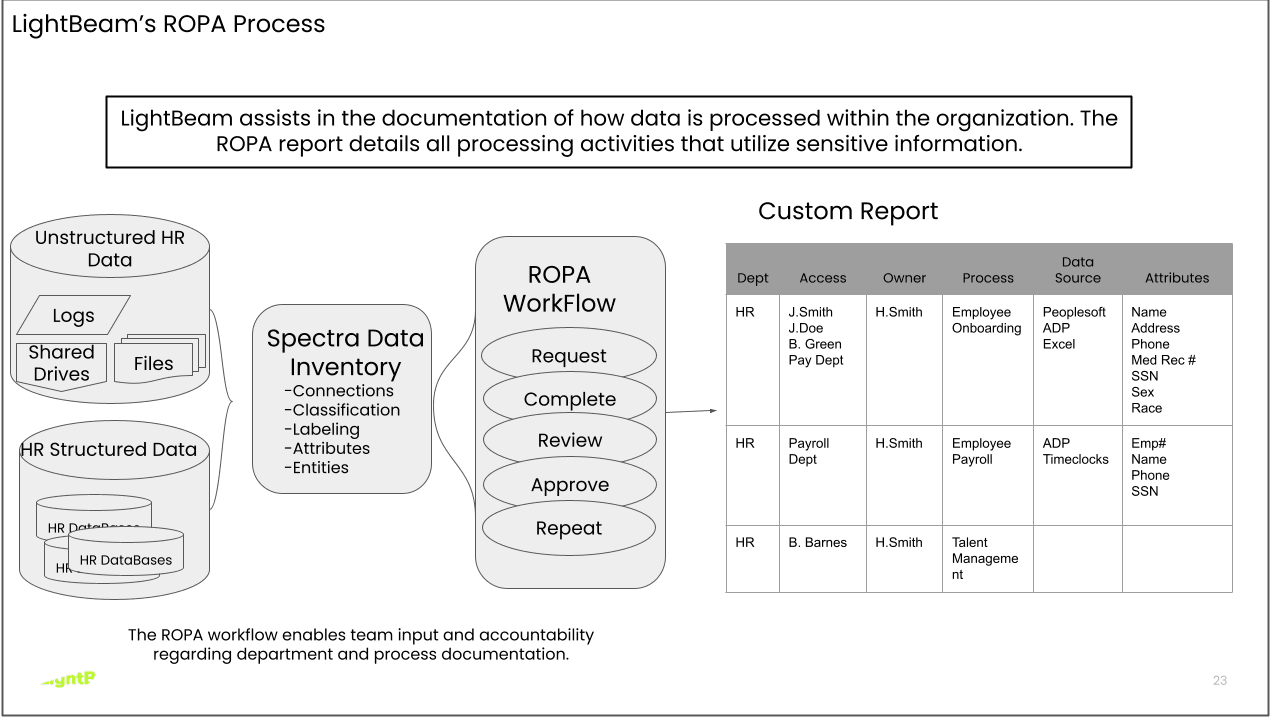
By investing in a well-structured and maintained RoPA using LightBeam, organizations can strengthen their privacy compliance posture, reduce risks, and unlock valuable business opportunities within minutes!
Do you want to see this in action? Schedule a demo with our Privacy experts today.
Frequently Asked Questions
Q1: What is a Record of Processing Activities (RoPA)?
A1: A RoPA is a detailed inventory that organizations must maintain under Article 30 of the GDPR, documenting how personal data is collected, processed, stored, transferred, and deleted.
Q2: Why is RoPA important for GDPR compliance?
A2: The RoPA serves as evidence of good privacy practices, supporting accountability, audit readiness, and regulatory transparency. It is a foundational requirement under GDPR’s Article 30.
Q3: What are the key elements of a RoPA?
A3: Core RoPA fields include: data controller/processor details, processing purpose, data categories, data subject types, recipients, retention period, and international transfers.
Q4: Can RoPA be automated?
A4: Yes. Platforms like LightBeam automate RoPA generation by scanning structured and unstructured data, mapping processing activities, and enabling real-time report creation.
Q5: How does RoPA support privacy by design?
A5: By making data processing visible and accountable, RoPA empowers cross-functional teams to embed privacy into systems and workflows from the outset.
