


Spring Release 2026: Automate Least Privilege, Classify Smarter, and Reduce Data Exposure Risk

Seth Knox
Table of Contents
Data security breaks down when visibility does not turn into action.
Security teams can find sensitive data, but still struggle to remove unnecessary access. Privacy teams can identify workflows, but still coordinate assessments and DSRs across spreadsheets, tickets, and manual follow-up. IT teams can define least privilege policies, but open access, inherited permissions, stale groups, and excessive entitlements still accumulate across enterprise data.
AI makes this problem more urgent. Copilots, agents, and automated workflows often inherit the same access available to users. If sensitive files are open to too many people, AI can expand the exposure path. If classification takes too long, governance cannot keep up. If audit logs stay isolated from the SOC, investigations slow down.
The Lightbeam Spring Release 2026 helps close that gap.
This release introduces Lightbeam PrivilegeIQ, a new capability that brings Zero Standing Privilege to identity-centric data security. It also introduces Smart Classify, Operational Visibility and SIEM integration, a PIA Dashboard, and DSR-JIRA integration to help security, IT, and privacy teams move from visibility to action.
PrivilegeIQ: Zero Standing Privilege for enterprise data
Least privilege has always been easy to define and hard to enforce.
Organizations understand the principle of least privilege, but enforcing it continuously is much harder. In day-to-day operations, access tends to expand faster than it contracts. Teams open folders to move projects forward, permissions cascade through parent folders, groups outlive their original purpose, external collaborators remain after work is complete, and employees often keep access long after their roles change. Over time, these small exceptions compound into broad, persistent exposure across enterprise data.
This permission sprawl creates a larger attack surface and a bigger breach blast radius. Every unnecessary permission gives attackers, insiders, compromised accounts, and AI tools more paths to sensitive data. When too many people can access too much data for too long, organizations face higher exposure risk, broader breach scope, more complex investigations, and higher potential breach costs.
Gartner describes the problem this way: “In addition to the problem of excess privileges (that is, people having more privileges than necessary), accounts have standing privileges (that is, people having privileges when they don’t actively need them). Their combination exposes an organization to higher levels of risk should any of these accounts be compromised or misused.”
PrivilegeIQ applies just-enough privilege and just-in-time access principles to enterprise data. It starts with one of the most common and urgent access governance problems: open access.
PrivilegeIQ automatically finds and removes open access across enterprise data. It identifies broad permissions, evaluates usage patterns, removes unnecessary access, preserves access for active users, and records every action for access review and audit evidence.

What’s new
- Automated identification of open access across enterprise data
- Usage-aware access evaluation to distinguish active users from unnecessary exposure
- Automated removal of broad permissions that expose data to more users than necessary
- Preservation of access for active users to reduce business disruption
- Audit logging for access reviews, compliance evidence, and governance reporting
- A foundation for moving toward just-enough and just-in-time access governance
PrivilegeIQ brings Lightbeam’s identity-centric approach to access governance. It does not treat access as a static permission list. It connects data, identity, usage, and business context so teams can answer the questions that matter: what data exists, whose data is it, who can access it, and whether that access should continue.
Smart Classify: AI-powered classification at scale
Classification creates the foundation for almost every data security, privacy, governance, retention, and AI control. But classification still becomes a bottleneck for many teams.
Unstructured data rarely follows clean rules. Documents vary by department, region, process, and business unit. Traditional pattern-matching tools can find obvious data types, but they often miss the meaning of a document. Manual review does not scale when teams need to classify millions of files across collaboration platforms, SaaS applications, file shares, and cloud storage.
Smart Classify moves classification from manual review to AI-assisted action.
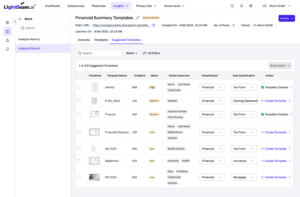
It uses AI to group similar documents by structure and context, then helps teams apply classification templates at scale. Instead of building rules for every document type from scratch, teams can identify patterns, classify related content consistently, and use those classifications to drive downstream governance.
What’s new
- AI-powered grouping of similar documents by structure and context
- Classification templates that can be applied at scale
- Faster classification of recurring document types and business templates
- Reduced manual reviewfor security, privacy, and governance teams
- More consistent labels for data protection, retention, privacy, and AI governance
- Stronger foundation for policy-driven remediation and access control
Smart Classify also supports AI security programs. If AI tools and agents can access data, organizations need a reliable way to know what that data contains, what it represents, and whether it should be available for AI use. Classification becomes the control point that helps teams prevent sensitive data from flowing into the wrong workflows.
Operational Visibility and SIEM integration
Data security operations needthe same level of observability that teams expect from endpoint, network, identity, and cloud security tools.
Security teams do not want important data security events trapped in a separate console. They need operational health, audit logs, policy actions, and data security context to flow into the systems where investigations already happen.
The Spring Release adds Operational Visibility and SIEM integration to make Lightbeam easier to monitor, verify, and connect to security operations workflows.
What’s new
- Real-time platform health visibility
- Email and in-app alerts for operational issues
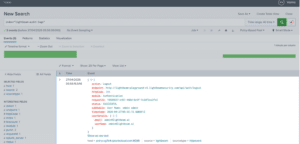
- Audit log forwarding to Splunk, Datadog, and CRIBL
- Better visibility into scans, policy evaluations, connectors, reports, and access governance workflows
- SOC-ready telemetry that brings Lightbeam context into existing investigation workflows
This helps teams operate Lightbeam as part of their broader security stack. Analysts can correlate data security activity with endpoint, identity, cloud, and network telemetry. Administrators can identify operational issues faster. Security leaders can get more confidence that data security controls are running as expected.
PIA Dashboard and residual risk
Privacy impact assessments often start with the right intent and end in fragmented execution.
Teams manage assessment status in spreadsheets. Risk ratings live in documents. Evidence is scattered across emails and shared folders. When leadership asks what has been assessed, what remains open, and what residual risk remains after mitigation, privacy teams often have to rebuild the answer manually.
The Spring Release introduces a PIA Dashboard and residual risk visibility to give privacy teams a more operational view of assessment activity.

What’s new
- Centralized view of privacy impact assessments
- Visibility into assessment status, completion rates, and risk levels
- Residual risk tracking after controls and mitigations
- Better prioritization of high-risk assessments
- More consistent reporting for privacy, compliance, and audit stakeholders
The goal is to help privacy teams move away from spreadsheet coordination and toward a live view of privacy risk posture. PIAs become easier to track, easier to prioritize, and easier to connect to the real data, identities, and access patterns that drive risk.
DSR-JIRA integration
Data subject requests require coordination across privacy, engineering, IT, and operations teams. But the people who execute the work often live in JIRA, while privacy teams manage request workflows in privacy systems.
That gap creates manual follow-up, status chasing, and missed handoffs.
The Spring Release adds DSR-JIRA integration so teams can connect Lightbeam DSR workflows to the operational systems where work gets done.

What’s new
- Automatic JIRA ticket creation from Lightbeam DSR workflows
- Status synchronization between JIRA and Lightbeam
- Reduced manual handoffs between privacy, engineering, and operations teams
- Better operational tracking for DSR fulfillment
- Less duplicate status entry and fewer follow-up gaps
This helps privacy teams keep requests moving while allowing engineering and operations teams to stay in their normal workflow. When teams close a JIRA ticket, the DSR workflow can advance in Lightbeam, reducing the manual coordination that slows privacy operations at scale.
Additional platform updates
The Spring Release also includes platform and integration enhancements that expand coverage, improve security operations, and reduce friction across enterprise environments.
What’s new
- Tines SOAR integration to support automated security workflows
- Amazon FSx support to expand coverage across file storage environments
- iManage support for legal and document-centric environments
- Cross-account S3 support for broader cloud data visibility
- TIFF OCR to improve classification coverage for image-based content
- Sybase and MariaDB support for structured data discovery
- PingFederate and PingOne SSO support
- Breach Response Report enhancements
- Blob scanning support
- Residual risk in PIA workflows
- Ignore attribute values for more precise classification tuning
Not every release update needs to be a headline feature to matter. These improvements expand where Lightbeam can operate, improve classification coverage, strengthen authentication options, and give teams more control over how data security and privacy workflows run.
From visibility to automated governance
The Spring Release continues Lightbeam’s shift from data security visibility to automated governance.
That shift matters because modern data risk is not a single problem. It is a chain of connected questions:
- What data do we have?
- Whose data is it?
- Who can access it?
- Is that access appropriate?
- What should we do next?
- Can we prove what happened?
The Lightbeam Data Identity Graph connects data objects, data subjects, accessor identities, and business context into a single operational model. That model powers the Spring Release: PrivilegeIQ uses it to reduce unnecessary access, Smart Classify uses it to improve classification decisions, privacy workflows use it to connect assessments and requests to real data, and operational visibility brings that context into security workflows.
The result is a platform that does more than find risk. It helps teams act on it.
See it in action
The Lightbeam Spring Release 2026 is available now.
To see how PrivilegeIQ, Smart Classify, Operational Visibility, PIA Dashboard, and DSR-JIRA integration help organizations automate least privilege, classify smarter, respond faster, and operate with confidence, request a demo.
Request a demo: https://lightbeam.ai/demo
Source note
Gartner, Reduce Risk Through a Just-in-Time Approach to PAM, Paul Mezzera, Nayara Sangiorgio, Michael Kelley, Abhyuday Data, Felix Gaehtgens, 11 April 2025, ID G00826290.
GARTNER is a registered trademark and service mark of Gartner, Inc. and/or its affiliates in the U.S. and internationally and is used herein with permission. All rights reserved. Gartner does not endorse any vendor, product or service depicted in its research publications and does not advise technology users to select only those vendors with the highest ratings or other designation.
