Sensitive Data in AI Pipelines: Why Data Classification Accuracy Is Now a Board-Level Problem

Henna
Table of Contents
- The Five Ways Classification Programs Create AI Pipeline Exposure
- The AI Training Pipeline: Why All Five Failures Now Have a New Consequence
- What Makes AI Training Pipeline Risk Specifically Hard to Control
- What the Auditor Asks, And What You Need to Answer It
- What Solving This Actually Requires
- Lightbeam Smart Classify, Built for This Problem
- The Board Question Has Changed
The stakes for getting data classification right have never been higher, and the reason has changed.
For years, the classification problem was about what left the building through the front door. An email with a customer record attached. An external share link on a file containing PII. A third-party vendor with access they shouldn’t have had. The threat model was legible: data moves, someone intercepts it, you get a breach notification.
That model is still real. But there is a new door, and most organizations haven’t fully looked at what is walking out of it.
AI agents are now operating inside the enterprise, ingesting documents, summarizing files, answering questions by pulling context from the data estate. They are doing exactly what they were designed to do. The problem is that they have no way to distinguish between a quarterly earnings summary and a folder containing employee health records, unless classification has already drawn that line. If it hasn’t, or if it’s wrong, the agent doesn’t hesitate. It processes what it can reach. And sensitive data, unclassified or misclassified, becomes part of the output.
This is the classification problem in 2026. Not whether the labels exist. Whether they are accurate enough to be the last line of defense between your most sensitive data and the systems now running on top of it.
The Five Ways Classification Programs Create AI Pipeline Exposure
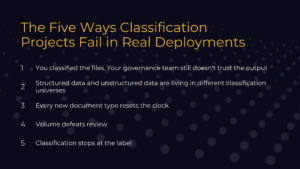
The AI pipeline risk described above is not one problem. It is five separate classification failures, each one creating a different kind of blind spot that an AI agent will find and exploit before your security team does.
1. You classified the files. Your governance team still doesn’t trust the output.
If your governance team doesn’t trust the classification output enough to enforce policy against it, your AI agents are operating without a meaningful content boundary. An AI system ingesting from a data estate where labels are treated as advisory rather than authoritative has, in practice, no classification layer at all.
The root cause is almost always the same: pattern-based classifiers were designed to find what they were told to look for. A tax form from 2019 and a tax form from 2024 look structurally different. A scanned PDF of an NDA and a digital NDA are processed by entirely different logic. The world produced documents that didn’t match the patterns, and the output accumulated noise that governance teams learned to distrust.
False positives are not just a nuisance. In enterprise environments, a false positive rate that governance teams can’t tolerate is a classification program that doesn’t exist in practice, and an AI pipeline with no guardrails.
2. Structured data and unstructured data are living in different classification universes.
A SQL database column containing social security numbers is one problem. A scanned PDF benefits form containing the same information is a completely different one. A screenshot of a wire transfer confirmation is a third. Most classification programs handle one of these reasonably well and treat the others as edge cases.
They are not edge cases, they are precisely the formats AI systems are hungriest for. Unstructured documents, PDFs, images, scanned forms: these are the content types AI ingestion pipelines prioritize because they contain the richest contextual information. They are also the content types that text-based classifiers were never designed to handle. The surface area most exposed to AI ingestion risk is the same surface area with the least classification coverage.
3. Every new document type resets the clock.
Enterprises acquire companies. They migrate platforms. They change the format of their onboarding forms, vendor contracts, and internal finance templates. Every time this happens with a pattern-based classifier, someone has to go back, define new rules, test them, and re-run scans on the new document population.
This creates a persistent classification gap, freshly acquired entities, newly created SharePoint sites, document formats introduced by operational changes — that accumulates unclassified until someone raises a ticket. AI agents do not wait for the ticket. They connect to the new data source immediately and begin ingesting whatever they can reach. The gap between when data arrives and when it is classified is exactly when the AI pipeline exposure window is open.
4. Volume defeats review.
At a certain scale, manual review of classification outputs is not a process. It is a fiction.
Organizations with tens of millions of documents cannot meaningfully audit classification at the file level. Sampling happens. A small percentage of flagged files get human eyes. The rest are trusted by default. When the underlying classifier is producing errors at even two or three percent, and you have twenty million files, you have hundreds of thousands of misclassified documents that no human has reviewed. The program dashboard says 94% classified. The AI pipeline sees 100% of the data, including the 6% the program hasn’t handled and the errors within the 94% it has.
5. Classification stops at the label. AI Governance requires the person.
A file labeled “financial data” tells the AI system what the document contains. It tells the AI system nothing about whose financial data it is, who should be able to access it, or what the risk consequence is of surfacing it in a response.
This is the failure mode that makes AI pipeline exposure particularly hard to investigate after the fact. When an auditor asks “whose data could have been ingested by this system?” a content label cannot answer the question. Only classification linked to identity, to the specific person whose data the document represents, can draw the boundary an AI system needs and produce the evidence trail an auditor requires. Classification programs that stop at content are underequipped for the governance questions that AI systems now generate constantly.
Each of these five failures existed before AI agents arrived. Organizations managed them, imperfectly, with workarounds and manual review and governance teams that learned to live with uncertainty. AI removes the tolerance. When a system is actively ingesting from your data estate at scale, every classification gap becomes an active exposure window, not a deferred compliance problem.
The AI Training Pipeline: Why All Five Failures Now Have a New Consequence
Each of the five failure modes above was costly before enterprise AI became a default infrastructure layer. They are significantly more costly now.
Here is the failure mode that most organizations have not yet walked through explicitly:
An employee uses Microsoft Copilot, an internal AI assistant, or a retrieval-augmented generation tool connected to enterprise document storage. The tool ingests context from files the user can access. The user can access a folder that contains, somewhere in its 40,000 documents, an unclassified benefits form, a scanned NDA with customer PII, a screenshot of a bank statement that was processed through an intake workflow and never labeled.
The AI system has no way to know these documents are sensitive. Sensitivity classification is the only signal it has. If that signal is absent, the document is treated as ordinary context.
The output of the AI query may now contain elements drawn from that sensitive document. It may be shared. It may be logged. In a retrieval-augmented system, it may be returned to users who would otherwise be unable to access the original file directly.
The question is not whether this can happen. It is whether your classification program is accurate enough, and complete enough, to prevent it.
What Makes AI Training Pipeline Risk Specifically Hard to Control
The challenge is not simply “classify more files.” It is that the three characteristics of data most likely to flow into AI training pipelines are the same three characteristics that pattern-based classifiers handle worst.
Unstructured documents at scale. AI ingestion pipelines are hungry for unstructured text, documents, PDFs, notes, emails, presentations. These are exactly the document types where format variation defeats pattern matching and where false negatives accumulate.
Legacy and scanned content. Organizations connecting AI tools to their full document estate often have years of scanned historical documents, intake forms, signed contracts, processed applications, that have never been classified because text-based scanners couldn’t read them. This content is precisely the highest-risk material from a PII and PHI standpoint, and precisely the content most likely to be invisible to the classifier.
Shadow data and newly ingested sources. AI tools frequently connect to data sources that were not part of the original classification scope, Teams channels, SharePoint sites created by individual teams, OneDrive folders, collaboration tools. Classification programs designed around a defined perimeter have no coverage of data that arrived or was created outside that perimeter.
The combination of these three factors means that the surface area most exposed to AI ingestion risk is systematically underrepresented in most enterprise classification programs.
What the Auditor Asks, And What You Need to Answer It
When a regulator or auditor asks about AI data governance, the questions are specific:
What sensitive data could have been ingested by your AI systems? How do you know your AI tools are not being trained on personal data? What controls are in place to prevent regulated data from entering AI pipelines? Can you demonstrate that those controls were operating correctly at the time of the audit period?
The only defensible answer to each of these questions runs through classification. You cannot answer “what sensitive data could have been ingested” without a classification system accurate enough to define the boundary. You cannot answer “what controls are in place” with anything other than classification-based exclusion policies. You cannot demonstrate those controls were operating without timestamped classification evidence.
A classification program that your governance team doesn’t fully trust, that has significant unstructured and scanned document gaps, and that stops at content labels rather than identity context, cannot produce these answers. The audit conversation goes badly.
What Solving This Actually Requires
Pattern-based classifiers were the right tool for a narrower problem. They were built to find specific content types in known document formats at manageable scale. The enterprise data estate in 2026, heterogeneous formats, petabyte scale, unstructured and scanned content, data flowing into AI systems, is a materially different problem.
What accurate classification at this scale requires is a system that learns document structure and context from the environment it is classifying, rather than from a predefined rule set. A system that can recognize that a 2019 onboarding form and a 2024 onboarding form are the same document type without being told, because it understands structural similarity, not just keyword patterns.
That system needs to do something pattern-based classifiers have never been able to do at scale: link every classification to the identity the document represents, not just a content label, but a connection to the specific person whose data it is, with access and risk context attached.
Lightbeam Smart Classify, Built for This Problem
Lightbeam Smart Classify is a Spring Release 2026 capability, and it was built specifically to close the gap between classification as a compliance exercise and classification as a governance foundation.
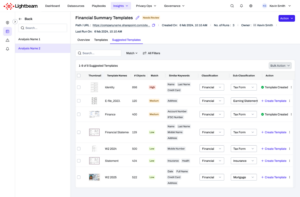
It starts with how it learns. Smart Classify does not require the security team to define every document type in advance. It scans the environment and identifies patterns, not just text patterns, but structural and contextual similarities between documents. When it detects a cluster of documents that share the characteristics of an onboarding form, a vendor NDA, or an employee exit questionnaire, it surfaces the pattern and presents a one-click option to apply the appropriate classification template to all matching documents enterprise-wide. The classifier learns from your environment. Not from a rule set someone wrote two years ago.
It handles what pattern matchers miss. Smart Classify is built for the heterogeneous data estate, structured data, unstructured documents, scanned PDFs, TIFF image files, blob fields in databases, content that has never been reachable by a text-based scanner. The sensitive information in a scanned benefits form is as visible to Smart Classify as the sensitive information in a digital contract. There are no blind spots by format.
It connects classification to identity. Every classification applied by Smart Classify is linked through Lightbeam’s Data Identity Graph to the person whose data the document represents — not just the file itself. A classified payroll record is not simply labeled “financial data.” It is tied to the specific employee identity it belongs to, with all access and risk context attached. This is the difference between knowing what a document contains and knowing whose data it is, who can reach it, and what the consequence of that access is.
This matters directly for the AI training pipeline problem. When classification is identity-linked, the question “whose data could have been ingested by this AI system?” has a precise, auditable answer. When it is not, that question cannot be answered at all.
It eliminates the volume problem. What previously required weeks of manual review, a governance team approving files one by one, sampling outputs, compensating for false positives, can be completed in hours. One scan. One click. One enterprise-wide classification sweep. The governance team moves from validating classification to acting on it, because the output is accurate enough to trust.
It solves the AI pipeline problem directly. Classified sensitive data, PII, PHI, regulated financial data, is systematically excluded from AI ingestion pipelines. When Copilot, an internal LLM, or a retrieval-augmented tool reaches into the document estate, it operates against a classification layer that defines the boundary of what it can and cannot ingest. The audit evidence that sensitive data was labeled and excluded is generated automatically, with timestamps, as part of the classification process itself.
When the auditor asks, what sensitive data could have been ingested by your AI systems, and how do you know it wasn’t? Smart Classify produces the answer. Not as a manual compilation exercise. As an output of the classification program that was already running.
The Board Question Has Changed
A year ago, the board question about data classification was: do we have a program?
In 2026, the question is: is our classification accurate enough to be the control layer for our AI systems?
Those are very different questions. The first can be answered by showing a dashboard. The second requires a structurally sound classification program, one where the output is trusted, the coverage is complete, the format gaps are closed, and every label is connected to an identity that governance can act on.
Classification has always been foundational. It is now also urgent. The AI systems are already running. The data is already flowing. The only question is whether the classification layer standing between your sensitive data and those systems is one you can defend, to your governance team, to your auditors, and to the board.
Lightbeam Smart Classify is part of the Spring Release 2026. It uses AI to group documents by structure and context, applies sensitivity templates enterprise-wide in a single click, and links every classification to the identity the data represents, with defensible audit evidence that sensitive data is excluded from AI ingestion pipelines.
See Smart Classify in action → Book a demo