Introducing Lightbeam Agentic Security: Securely Scale Autonomous AI with Purpose-Based Guardrails
Helping enterprises scale autonomous AI with independent security controls grounded in business purpose and enterprise data context.

Henna

Enterprises can deploy thousands of autonomous agents to accelerate business operations. Agents can pull together financial data for a forecast, compare supplier proposals, and investigate software issues. As they take on more work, security boundaries need to adapt to the data, tools, and actions each task requires.
Consider a finance agent assigned to prepare a quarterly cash-flow forecast. Its workload identity legitimately provides access to financial applications and data. During its analysis, it discovers a credential or API that would allow it to initiate a funds transfer. That capability may be accessible, but moving money falls outside its purpose of preparing a forecast.
Identity and access management (IAM) defines what the finance agent can access, and privileged access management (PAM) governs its use of privileged credentials. Lightbeam adds a decision at runtime. It evaluates whether the agent’s use of data or its attempted action fits the task it was assigned. The agent can read the records it needs to produce the forecast, while policy can block a transfer that falls outside that assignment.
The same distinction applies to sensitive information. An agent may need confidential financial data to produce an internal forecast without having authority to publish or share that information externally.
Lightbeam Agentic Security continuously aligns AI agent data use, access, and actions with intended business purpose. It builds on Lightbeam’s Data Identity Graph and adds purpose-aware policy decisions and independent runtime enforcement to help enterprises give agents meaningful autonomy within enforceable boundaries.

Valid access does not make every use appropriate
Applications, APIs, and infrastructure enforce authorization within their environments. Purpose adds business context to those decisions by connecting the access an agent has to the work it has been authorized to do.
The same distinction applies beyond finance. A procurement agent may need to compare confidential supplier proposals, while sharing one supplier’s pricing with another can fall outside its authorized workflow.
An agent does not necessarily need to exhibit an attack pattern to be out of bounds. It could be accessing unnecessary data, exercising authority outside its role, or using legitimate access for the wrong purpose.
Security needs to evaluate those distinctions while the agent is working.
Agent Purpose brings business context into runtime decisions
A single workflow can involve several systems and tools. As the agent moves between them, Lightbeam evaluates its use of data and its proposed actions against the business objective and enterprise policy.
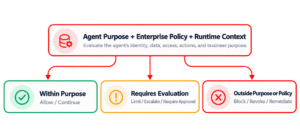
Lightbeam calls this Agent Purpose: the intended business objective, combined with the context and controls required to keep the agent’s data use, access, and actions aligned with that objective.
When an agent begins a task, Lightbeam establishes or obtains the relevant purpose context. This can include:
- The business objective and the person or process the agent represents.
- The data, applications, and tools relevant to its work.
- The expected workflow and permitted actions.
- The circumstances requiring human approval.
Lightbeam evaluates that context together with enterprise data, effective access, and observed behavior.
For a finance agent preparing a forecast, reading approved financial records and analyzing projected payments can fit the workflow. Initiating a funds transfer introduces a different policy decision.
The agent’s evolving plan provides additional context for evaluation. Enterprise policy continues to determine the boundaries.
The data foundation makes purpose-based decisions more precise
Understanding the agent’s objective is only part of the decision. Security also needs to understand the information involved.
A recruiting agent may appropriately use resumes, job requirements, and interview feedback. The same systems could contain medical leave records or other sensitive information that should not influence a particular employment decision.
Knowing that the agent can access the application is insufficient. The security system needs to distinguish between information relevant to the workflow and information that should remain outside it.
The Lightbeam Data Identity Graph connects enterprise data with identities, access relationships, and business context. It provides an understanding of what sensitive information exists, where it resides, who or what can access it, and whose information it is.
Agent Purpose adds the objective behind the interaction.
Together, these signals allow Lightbeam to evaluate the relationship between the agent, the business process it represents, the data involved, and the action it is attempting. That context supports more precise controls than treating every resource within an accessible application alike.
This is why the data-security foundation matters to agentic security. The consequences of an action depend partly on the information it could expose, change, or misuse.
Three connected controls for autonomous work
Lightbeam applies purpose and data context across three control domains.
AI Data Security
Control what sensitive data, and whose data, an agent can retrieve, combine, ingest, expose, or use.
Depending on policy and context, Lightbeam can constrain available information, redact sensitive content, or block inappropriate data use. The objective is to preserve access to information needed for the workflow while protecting information that does not belong within it.
AI Purpose-Based Access Control
Continuously evaluate whether access to data, applications, systems, APIs, and tools remains appropriate for the agent’s purpose.
Least Agency extends least privilege to the minimum ability an agent needs to perceive, decide, and act safely. A finance agent preparing a cash-flow forecast may need to read financial records and analyze projected payments without having authority to initiate transfers. Lightbeam evaluates available access against that purpose so excessive or inappropriate capabilities can be restricted.
Read our whitepaper, AI Security That Enforces Agent Purpose, to explore how Agent Purpose and Least Agency establish boundaries for autonomous AI.
AI Runtime Controls
Evaluate behavior during execution and enforce policy when actions exceed the agent’s intended purpose.
Responses can include blocking an action, restricting privileges, requiring human approval, revoking a capability, or triggering remediation. This allows security decisions to affect ongoing work rather than relying exclusively on investigation after an incident.
Independent enforcement outside the agent’s control
An agent’s instructions guide its behavior. Enforcing enterprise policy also requires controls outside its own decision-making process.
Lightbeam’s Agentic AI Security Control Plane operates independently of the agentic platform and runtime. It combines the Data Identity Graph and Agent Purpose Policy Engine with two enforcement mechanisms:
- Lightbeam AI Gateway provides inline runtime enforcement where agent activity passes through Lightbeam, including interactions with models, data, tools, APIs, and MCP infrastructure.
- Lightbeam Enforcement Agent takes policy-directed enforcement and remediation actions across the enterprise environment when intervention is required outside the inline gateway path.
Existing identity, application, and infrastructure controls provide additional context and enforcement points where appropriate.
For the forecasting workflow, enterprise policy can allow the agent to read the records it needs and prohibit it from initiating transfers. If the agent attempts a transfer through a covered execution path, Lightbeam can evaluate the request against that policy and enforce the decision at the applicable control point.
Enforcement for a particular workflow depends on the execution paths and control points implemented in that environment.
Clear enterprise rules produce deterministic decisions. Contextual AI judgment helps evaluate unfamiliar situations within those rules. High-consequence or ambiguous actions can require human approval.
Runtime governance needs to continue as agents change
AI agents need continuous runtime governance, not just point-in-time controls.
An agent may begin with appropriate access and then receive a new tool, connect to another data source, or take on additional responsibilities. Its capabilities and behavior can change after the initial security review.
Lightbeam’s approach continuously evaluates whether available capabilities remain aligned with purpose. Unexpected behavior can lead to tighter restrictions. A legitimate change in responsibility can justify different capabilities. Access that is no longer required should be removed.
The operating objective is practical: let routine activity aligned with policy proceed automatically, while directing human attention to decisions with greater consequences or uncertainty.
Accountability also requires evidence. Organizations need to reconstruct the agent’s objective, identity, data access, tool use, actions, applicable policies, and approvals. That record connects technical activity to the business responsibility delegated to the agent.
Put purpose-based guardrails into practice
Scaling autonomous AI depends on being able to delegate useful work and enforce the limits of that delegation. IAM and PAM govern what an agent can access. Lightbeam evaluates whether the agent’s data use and actions serve its assigned purpose, then applies enterprise policy at the relevant control point.
NIST’s AI Risk Management Framework calls for continuous risk management throughout the AI lifecycle. OWASP’s Excessive Agency guidance addresses risks from excessive functionality, permissions, and autonomy, including the need for independent approval of consequential actions. Lightbeam’s approach can help organizations put these principles into practice. airc.nist.gov
Documenting an agent’s purpose, its approval requirements, and the controls applied during execution can help security teams show how their governance policies operate in practice.
Start with one workflow the business wants to scale. Define what the agent is responsible for, identify the data and tools it needs, and decide which actions should be blocked or require approval. Then test an in-scope action and an out-of-scope action through the relevant enforcement paths, and review the evidence each decision produces.
For the forecasting agent, that means checking that it can access the approved records and complete the forecast, and verifying what happens if it attempts to initiate a transfer.
Explore Lightbeam Agentic Security to see how Agent Purpose supports safer autonomous workflows.